
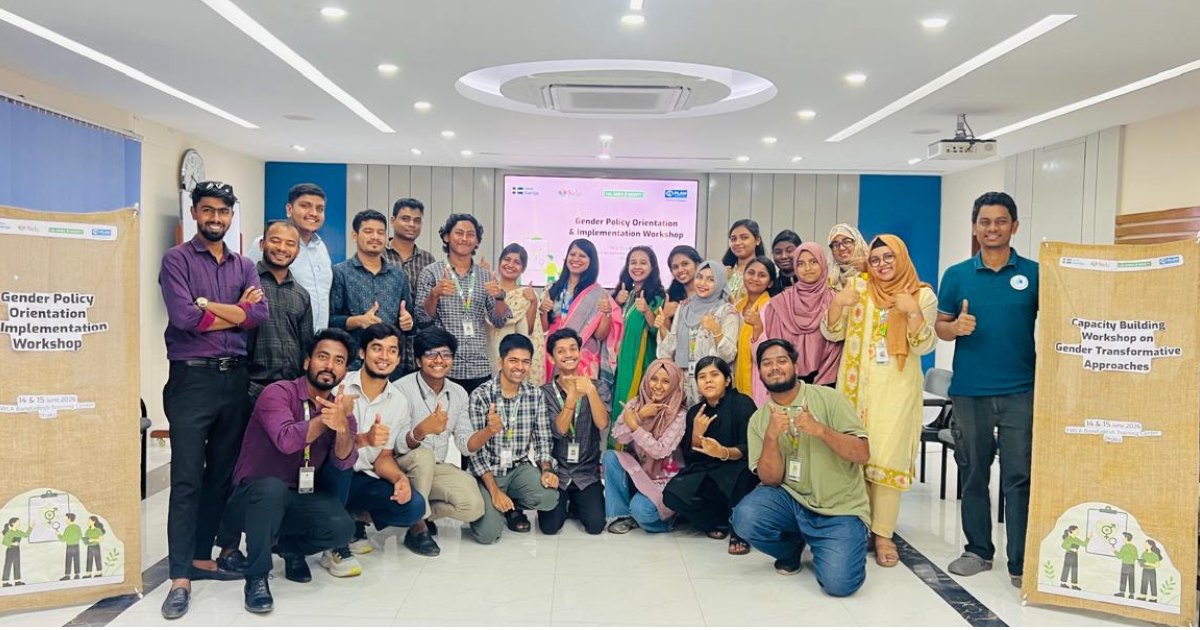
Lal Sabuj Society organized a two-day workshop on Gender Policy Review and Capacity Building on Gender Transformative Approaches on 14–15 June at the YWCA Conference Room in Dhaka under the Space to Lead Project of Plan International Bangladesh. The workshop brought together staff members from different departments of the organization and representatives from district volunteer teams to strengthen organizational understanding and practice of gender equality, inclusion, and gender-transformative programming.
The workshop aimed to review Lal Sabuj Society’s existing Gender Policy, identify its strengths and areas for improvement, and explore ways to further integrate gender-transformative approaches into organizational policies, systems, and programs. The initiative also focused on promoting a safe, inclusive, and equitable environment for staff, volunteers, and the communities the organization serves.
The sessions were facilitated by Sanjida Ahmed, GDIP Advisor at Plan International Bangladesh, and Joyeta Hossain from Nagorik Uddyog. Through interactive presentations, group exercises, practical learning sessions, and participatory discussions, the facilitators engaged participants in exploring key issues related to gender equality, social inclusion, safeguarding, power dynamics, intersectionality, and institutional accountability.
A major focus of the workshop was capacity building on Gender Transformative Approaches (GTA). Participants gained a deeper understanding of how gender-transformative approaches go beyond addressing immediate gender issues by challenging the root causes of inequality, discriminatory social norms, unequal power relations, and structural barriers. Discussions highlighted practical strategies for integrating gender-transformative principles into organizational policies, programs, and day-to-day practices to ensure meaningful and sustainable change.
Through case studies, group reflections, and collaborative exercises, participants examined how social norms and gender stereotypes influence individual behavior, institutional culture, and community engagement. They also explored ways to promote inclusive decision-making, equitable participation, and gender-responsive leadership within both organizational and community contexts.
A significant component of the workshop was the comprehensive review of Lal Sabuj Society’s current Gender Policy. Participants worked in groups to assess the policy’s effectiveness, identify existing gaps, and provide recommendations for improvement. Their feedback and suggestions were documented to support the policy revision process and ensure that the updated policy remains practical, inclusive, and responsive to emerging organizational needs.
The workshop created a vibrant platform for learning, dialogue, and collective reflection. Participants emphasized the importance of continuous capacity development, regular policy review, and strong institutional commitment to advancing gender equality and inclusion.
The recommendations generated during the two-day workshop are expected to contribute significantly to strengthening Lal Sabuj Society’s Gender Policy and reinforcing the organization’s commitment to promoting gender justice, inclusion, and transformative social change.